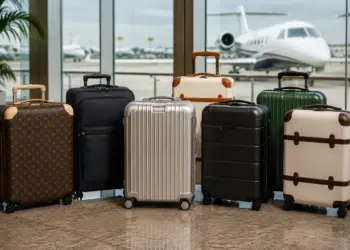


The luggage industry sells a lot of promises. A few of them are worth paying for.
There is a specific kind of luggage regret that arrives not at the point of purchase but approximately eighteen months after it, when the zipper starts catching on the third trip, the wheel housing develops a crack that turns a smooth roll into an irregular drag, or the telescoping handle begins its gradual decline from a crisp click to a looseness that never quite locks. The suitcase looked reasonable in the store and performed adequately for a year and now it is failing in the precise ways that suitcases always fail when they were not built to last, and the process of researching, choosing, and buying luggage begins again from the beginning. This cycle is not inevitable. The durable travel suitcase is a genuinely achievable purchase at a range of price points, provided the buyer understands what durability actually means in the context of luggage construction, which materials and components deliver it, and which brands have the track record and the warranty terms to stand behind the claims they make in their marketing. The gap between a suitcase that lasts two years and one that lasts twenty is real, it is largely explicable by specific construction decisions rather than brand prestige, and it is navigable with the right information.
What Luggage Actually Goes Through
Understanding why luggage fails requires understanding what it experiences in normal use, which is considerably more demanding than the smooth-rolling airport scenes in luggage advertising suggest. A checked bag on a typical international trip is lifted, dropped, thrown, stacked under other bags, conveyed on systems designed for efficiency rather than gentleness, loaded into aircraft holds by handlers working under time pressure, and delivered to a baggage carousel where it may travel for some time before collection. It experiences impact, compression, moisture, temperature variation, and the specific stress of being pulled across surfaces ranging from polished airport floors to cobblestones, gravel, and the textured pavement of every city it visits. The components that fail first in poorly constructed luggage are predictable: wheels, because they bear the full weight of the bag and experience continuous friction; the telescoping handle, because it cycles through extension and retraction thousands of times and is subjected to lateral force when the bag is pulled on uneven surfaces; zippers, because they are the primary closure mechanism and experience stress at both the pull and the teeth; and the shell or fabric, because it is in direct contact with every surface the bag encounters and is subjected to impact, abrasion, and in the case of soft-sided bags, puncture. A durable suitcase addresses each of these failure points with specific construction decisions. Understanding those decisions is what separates an informed purchase from one that relies on brand reputation and attractive design.
Hard Shell Versus Soft Side: The Genuine Trade-offs
The choice between hard-shell and soft-sided construction is the first significant decision in suitcase selection, and it involves genuine trade-offs rather than one option being straightforwardly superior. Hard-shell cases, constructed from polycarbonate, aluminum, or polypropylene, offer structural protection for contents, resistance to compression under other bags in the hold, and in the best constructions a weatherproofing quality that soft-sided bags cannot match. They do not expand to accommodate overpacking. They can crack under sufficient impact, though high-quality polycarbonate is considerably more resilient than its light weight suggests. And they transfer impact directly rather than absorbing it, which can matter for fragile contents. Polycarbonate is the material that balances durability, weight, and cost most effectively across the hard-shell category. It flexes under impact rather than cracking, and quality polycarbonate cases from reputable manufacturers are genuinely resistant to the normal handling that destroys cheaper alternatives. The textured or ribbed surface treatments on most polycarbonate cases serve a structural function as well as an aesthetic one: the geometric patterns distribute impact stress across the surface rather than concentrating it at a single point. Aluminum cases, associated most prominently with Rimowa’s original product and its imitators, are the most durable hard-shell option by a significant margin but also the heaviest and most expensive. An aluminum case will outlast any polycarbonate alternative under equivalent use, and its resistance to deformation means it retains its structural integrity after impacts that would crack or stress a polycarbonate shell. The trade-offs are weight, which matters for travelers close to airline baggage limits, and cost, which is substantially higher than polycarbonate at equivalent quality. Soft-sided cases, constructed from ballistic nylon, polyester, or Cordura fabric over an internal frame, offer expandability, lighter weight than equivalent hard cases, and a flexibility that allows them to be compressed into overhead bins and tight storage spaces that rigid cases cannot negotiate. The best ballistic nylon constructions, associated most credibly with Briggs and Riley’s baseline product, are extraordinarily resistant to abrasion and tearing. The trade-off is reduced structural protection for contents and greater susceptibility to moisture penetration, though quality soft cases use water-resistant coatings and sealed zippers that address the latter substantially.
The Components That Define Longevity
Shell or fabric material is one determinant of suitcase durability. The components attached to it are equally important and more frequently the point of failure in otherwise well-constructed cases. Wheels are where the most significant quality variation exists across the luggage market. Cheap wheels use small-diameter plastic rollers that offer high rolling resistance, wear quickly, and fail at the housing before the wheel surface itself is exhausted. Quality wheels use larger diameter rollers with ball bearing mechanisms that distribute load, reduce rolling resistance, and maintain smooth function across many more miles of use. The wheel housing, the point at which the wheel assembly attaches to the case shell, is the failure point in many mid-range cases: it is typically a separate component bonded or screwed to the shell, and the bond or screw point weakens under the lateral stress of pulling a heavy bag across uneven surfaces. The best wheel systems, found on cases from brands including Rimowa, Briggs and Riley, and Tumi, use recessed wheel housings integrated into the shell structure rather than attached to its surface, and wheel assemblies that can be replaced when they wear rather than requiring the entire case to be retired. Spinner wheels, the four-wheel configuration that has become standard on most contemporary cases, offer easier maneuverability than two-wheel designs but introduce twice as many potential failure points: a case that loses one of four spinners is significantly less functional than one that loses one of two inline wheels, making the quality of the spinner mounting more rather than less important than in traditional designs. Zipper quality is the difference between a case that maintains its closure integrity for years and one that begins to fail within months. YKK zippers, the standard specified by quality luggage manufacturers, are significantly more durable than the unbranded alternatives found on budget cases, with consistent tooth engagement, smooth operation, and resistance to the salt, moisture, and mechanical stress that accelerate zipper failure. The zipper pull and slider are the components that typically fail before the teeth themselves: quality sliders maintain consistent tension on the zipper chain, while cheap sliders develop play that causes the zipper to partially open under the stress of a fully packed case. Telescoping handles cycle through more mechanical stress than any other component on a frequently used suitcase, and their quality determines whether the bag remains comfortable to use as it ages. The best handle systems use aluminum tubes with machined rather than molded locking mechanisms, multiple height stops, and a positive lock engagement that does not develop play with use. The feel of a handle, its rigidity when extended and the crispness of its lock, is one of the most reliable indicators of overall construction quality when evaluating a suitcase in a store.
The Brands With Genuine Track Records
The premium luggage market contains brands whose reputations are built on genuine product quality and brands whose premium pricing reflects marketing investment more than construction. Distinguishing between them is most reliably done through warranty terms, which reveal how confident a manufacturer is in its product’s longevity, and through the independent assessment of travelers who have used the cases over multiple years. Briggs and Riley occupies a distinctive position in the market through its unconditional lifetime guarantee, which covers repair of any damage, including airline damage, regardless of cause, for the life of the product. This warranty has no registration requirement, no proof of purchase requirement for repair, and has been honored consistently enough that it functions as genuine reassurance rather than a marketing claim. The construction quality of Briggs and Riley’s baseline Baseline collection matches the warranty: the CX expansion-compression system, which allows the case to be overpacked and then compressed back to its original dimensions by the zipper closure, is a proprietary mechanism with no equivalent in competitor products, and the ballistic nylon construction is among the most abrasion-resistant soft-sided material in the consumer market. Rimowa’s aluminum cases carry a lifetime guarantee and a construction quality that justifies the significant price premium over polycarbonate alternatives for travelers who want the most durable hard-shell option available. The brand’s polycarbonate Essential line offers considerably better value for travelers who want Rimowa’s wheel quality and warranty without the aluminum price point, though at a higher cost than competitors whose polycarbonate construction is comparable. Osprey, better known for backpacks than wheeled luggage, applies the same lifetime guarantee and construction philosophy to its Transporter series of wheeled duffels and hybrid cases, producing products that perform particularly well for travelers whose itineraries combine air travel with overland movement where wheeled cases are less practical. Away occupies an interesting middle position: its direct-to-consumer model produces polycarbonate cases at prices below traditional retail-channel competitors of equivalent construction quality, and its lifetime warranty covers manufacturing defects. The warranty is less comprehensive than Briggs and Riley’s unconditional coverage, but the price-to-quality ratio at the mid-range price point is competitive with any alternative in the category.
Size, Weight, and the Airline Dimension
Suitcase selection happens in the context of airline baggage policies that constrain both the dimensions and the weight of checked and carry-on luggage, and the most durable case in the market is the wrong purchase if it exceeds the size limits of the airlines most frequently flown or if its empty weight consumes a significant proportion of the checked baggage allowance. Carry-on size limits vary between airlines and have been subject to tightening in recent years, particularly on European low-cost carriers whose cabin bag dimensions have become a significant revenue mechanism. A carry-on case sized to the generous limits of a full-service long-haul carrier may not fit in the overhead bins of a budget carrier on the connecting flight, and the cost of gate-checking a carry-on on a carrier that charges for checked bags can approach the cost of a checked bag allowance for the entire trip. The weight of the empty case matters most for travelers on airlines with low checked baggage weight allowances, typically 20 to 23 kilograms on economy international tickets, where a heavy case consumes a meaningful proportion of the available allowance before any clothing or equipment is packed. Aluminum cases are the most penalized on this dimension: a quality aluminum carry-on case may weigh four to five kilograms empty, compared to two to three kilograms for an equivalent polycarbonate case. For travelers packing light or operating close to weight limits, this differential is material.
The Honest Calculation on Price
The durability argument for premium luggage is most convincing when the calculation is done honestly across the full replacement cycle rather than as a single purchase comparison. A budget suitcase purchased for fifty to eighty dollars that requires replacement after two years costs more over a decade than a premium case purchased for four hundred dollars that requires no replacement over the same period, and less per year than a mid-range case that lasts five years and costs one hundred and fifty dollars. The numbers shift depending on how frequently the case is used, how it is treated, and whether the failure mode is catastrophic or gradual, but the general principle holds: for frequent travelers, the total cost of ownership calculation favors quality over initial price in a way that the purchase moment obscures. The caveat is that the premium price must be accompanied by genuine construction quality and warranty terms that back it up, rather than brand prestige and design alone. The brands that earn the premium are those whose lifetime guarantees are unconditional, whose components are repairable rather than requiring full case replacement when they fail, and whose construction quality is documented by travelers who have used them across years of frequent travel rather than by marketing materials and retail display units. The durable suitcase is not the one that looks most impressive in the store. It is the one that looks approximately the same five years later, rolls as smoothly, locks as crisply, and zips as cleanly as it did on the first trip. That case exists, it is available at more than one price point, and it is worth finding before the cycle of mediocre replacements begins again.