
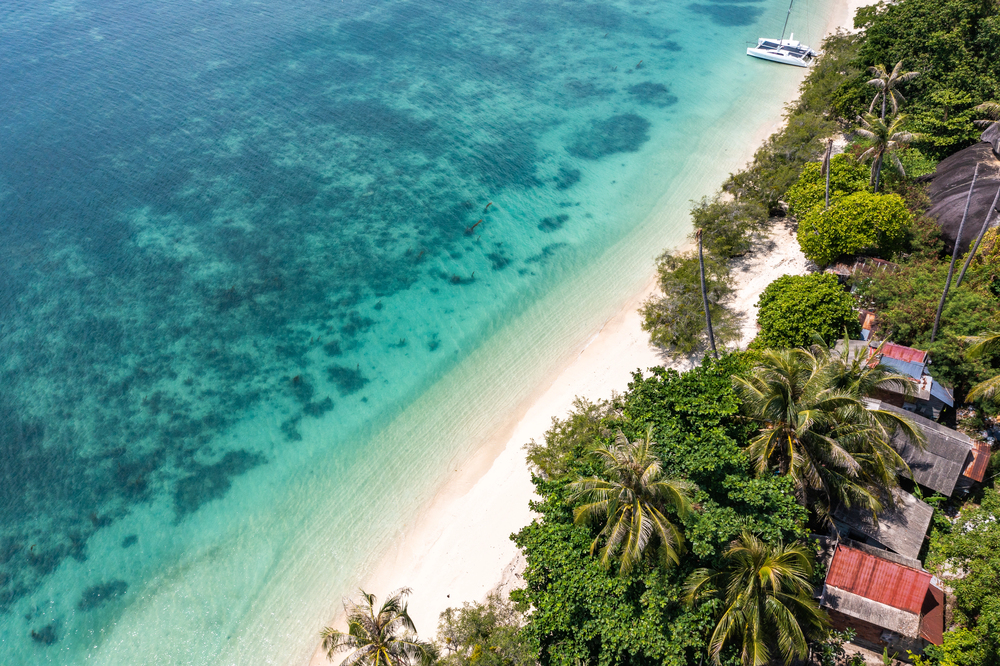

The best islands right now are the ones most people fly over on the way to somewhere else.
There is a particular kind of disappointment that comes from finally visiting an island you’ve wanted to see for years. The water is exactly as blue as the photographs promised. The sunsets deliver. And yet something is off — the taverna that used to be a local secret now has a QR code menu and a two-hour wait, the narrow harbor road is gridlocked with rental ATVs, and the charming fishing village turns out to be a charming fishing village surrounded by four hundred identical Instagram accounts being made simultaneously.
This is not nostalgia for a golden age that probably never existed quite the way we remember it. It’s a practical observation: the most marketed islands in the world have, in many cases, become victims of the very qualities that made them worth marketing. Mykonos, Ibiza, Bali, Santorini — they remain beautiful. They are no longer, in any meaningful sense, undiscovered.
The good news is that islands, by their nature, multiply. There are thousands of them, scattered across every ocean and sea, and the gap in quality between the famous ones and the quietly exceptional ones has never been smaller. Infrastructure improves. Direct flights appear. And yet the crowds haven’t followed. Not yet.
Faroe Islands, North Atlantic
The Faroe Islands sit in the North Atlantic between Norway and Iceland, an autonomous territory of Denmark that most people couldn’t place on a map until fairly recently. That is changing, but slowly enough that the islands still feel genuinely remote in a way that very few places in the Northern Hemisphere do anymore.
The landscape is unlike anything in conventional island tourism. No beaches to speak of, no palm trees, no turquoise shallows. Instead: sheer sea cliffs dropping hundreds of meters into Atlantic swells, villages of grass-roofed houses clinging to hillsides above fjords, roads that tunnel through mountains and emerge above clouds. The light changes every twenty minutes. The weather arrives without warning and leaves the same way.
Summer is the window, roughly May through August, when daylight stretches long enough to hike the ridgelines and reach the sea stacks at Drangarnir or the lake at Sørvágsvatn that appears, from certain angles, to hover above the ocean. The culinary scene in the capital Tórshavn is small but genuinely impressive, built around fermented, dried, and smoked local produce in ways that feel rooted rather than trendy.
The Faroes reward visitors who arrive with flexibility and genuine curiosity. They punish those who arrive with a fixed checklist and an intolerance for unpredictable weather.
Gozo, Malta
Most people who visit Malta spend their time on the main island, which is historically rich and genuinely interesting but also, in peak summer, quite crowded. Gozo, a twenty-minute ferry ride to the northwest, is a different proposition entirely.
Smaller, quieter, and noticeably more agricultural, Gozo moves at a pace that Malta proper largely abandoned some years ago. The inland villages are built in honey-colored limestone around baroque parish churches of disproportionate grandeur, a legacy of the island’s deep Catholicism and civic pride. The Ggantija temples, older than Stonehenge and older than the Egyptian pyramids, sit on a hill above the village of Xaghra with considerably less fanfare than their age warrants.
The coastline has the same clarity of water as anywhere in the central Mediterranean but without the infrastructure that tends to arrive alongside it. Ramla Bay, the island’s main beach, is a sweep of rust-colored sand backed by low dunes. The diving around the island, particularly at the Blue Hole near Dwejra, is considered among the best in Europe.
Gozo works well as a two or three-night extension to a Malta trip, or perfectly well as a destination in its own right for anyone who finds Malta’s pace too urban for what they’re looking for.
Vis, Croatia
Croatia’s coast is among the most beautiful in the Mediterranean, and it is no longer a secret by any definition. Dubrovnik has its crowds, Hvar has its nightlife reputation, Split has its cruise ships. Vis sits further out in the Adriatic than any of the other inhabited Croatian islands, far enough that day-trippers from the mainland rarely bother.
Until the 1990s, Vis was a Yugoslav military base and closed to foreign visitors entirely. That history left it without the tourist infrastructure that developed on other Croatian islands during the same period, and while it has caught up in many respects, it retains a quality of genuine local life that more accessible islands have diluted. The two main towns, Vis town and Komiža, are working fishing communities first and tourist destinations second, which is a distinction that matters enormously when you’re actually there.
The food on Vis has a serious reputation. The local wine, Vugava, is produced in small quantities from a grape variety found almost nowhere else. The sea around the island is exceptionally clear. The Blue Cave on the nearby islet of Biševo, where light enters through an underwater opening and turns the interior an extraordinary electric blue, is among the most genuinely surprising natural experiences in the Adriatic.
Nias, Indonesia
Bali’s gravitational pull on travelers to Indonesia is understandable and, for many people, entirely worth following. But it means that islands of comparable beauty a short flight away remain largely unknown outside specialist surf and dive communities.
Nias, off the western coast of Sumatra, is one of them. The island has a distinctive megalithic culture, stone monuments and ceremonial architecture that predate Hindu or Islamic influence in the region, and village structures in the south of the island, particularly Bawömataluo, that have survived largely intact and are recognized by UNESCO for their significance.
The surf at Lagundri Bay on the southern coast has been known to serious wave riders since the 1970s and is considered one of the most consistent right-hand breaks in the world. Outside of surf season, the bay is calm enough for swimming and the area around it quiet enough that the pace of the place, unhurried, slightly outside of time, becomes the main attraction.
Infrastructure is more limited than Bali and travel requires more planning. That barrier to entry is, in the current landscape of Indonesian tourism, something close to an asset.
São Tomé, Gulf of Guinea
São Tomé and Príncipe is a two-island nation in the Gulf of Guinea, roughly 250 kilometers off the coast of Gabon, and it receives a fraction of the attention that other Atlantic island destinations attract. This is largely a function of access and familiarity rather than any deficiency in what the islands offer.
The interior of São Tomé is covered in equatorial rainforest of genuine density, cut through with rivers and hiking trails that reach the volcanic peaks at the island’s center. The coastline alternates between black volcanic sand beaches and long stretches of pale sand backed by coconut palms. The Portuguese colonial architecture in the capital, also called São Tomé, is faded and atmospheric in the way that only genuine age produces.
The cocoa grown on the islands has developed a serious reputation among chocolate producers in Europe and North America, a legacy of plantation agriculture that left complicated historical traces and extraordinary raw ingredients. Food tourism around cacao, combined with the hiking and the beaches, gives the island a layered appeal that goes beyond any single category.
Direct flights from Lisbon make access considerably easier than the island’s obscurity might suggest.
The Pattern Worth Noticing
The islands above are not united by climate or geography or price. What connects them is a particular moment in their relationship with visitors, known enough to be accessible, not yet shaped by the requirements of mass tourism into something easier and blander than what they actually are.
Every island on this list will, at some point, appear in a mainstream travel supplement as the next place everyone needs to visit. Some are closer to that moment than others. The Faroes are already arriving there. Vis is not far behind.
The window in which a place rewards genuine curiosity rather than just confirming what the photographs promised is real, and it is finite. These islands are still in it.