
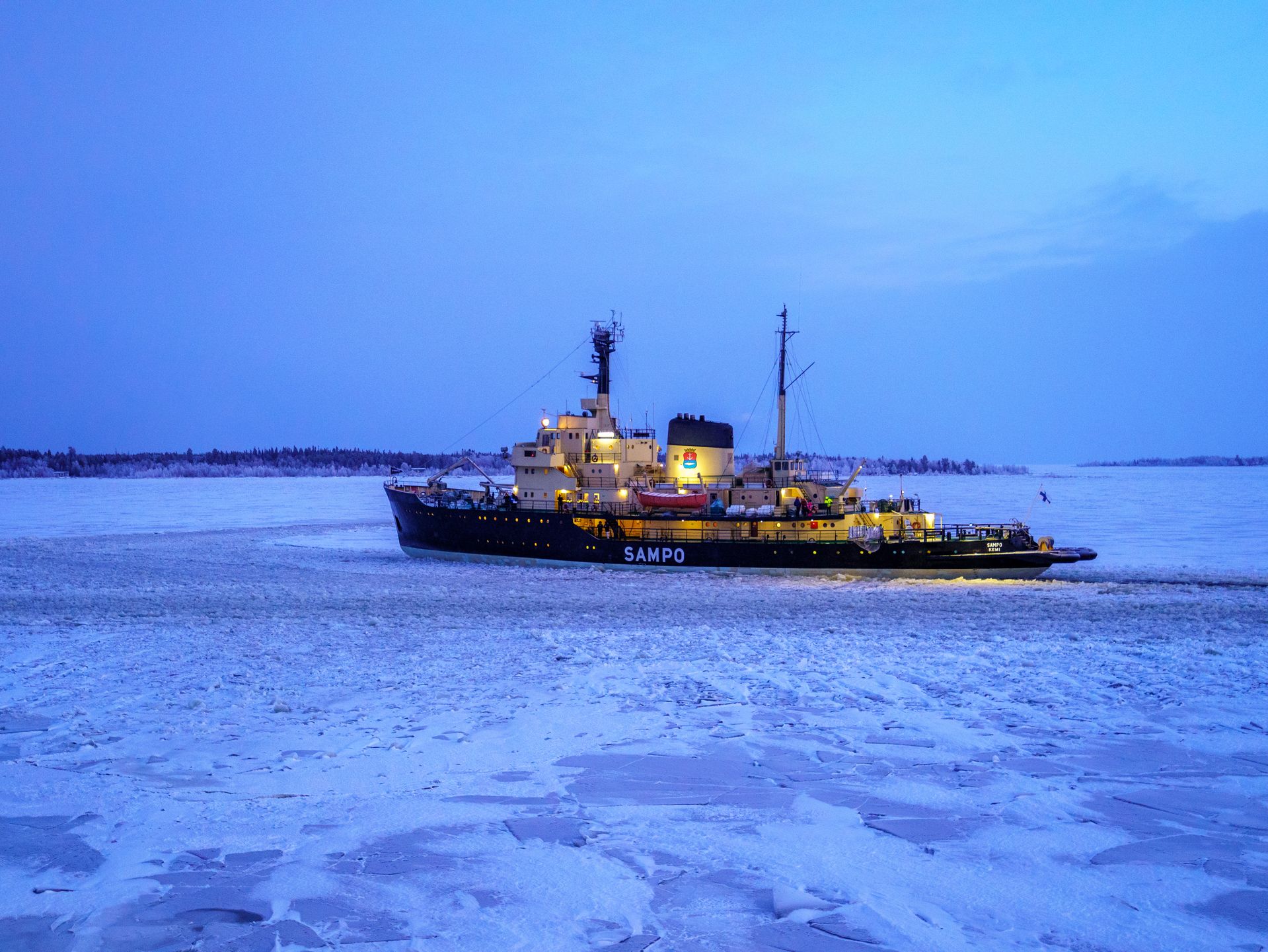

There is a moment that nearly every traveler on an arctic cruise describes in almost identical terms, regardless of where they boarded, which operator they sailed with, or which corner of the High North their itinerary covered. It is the moment the engine noise drops, the ship slows, and several hundred square meters of silence arrive all at once. Ice in every direction. A sky that has not decided between blue and white. And the particular quality of stillness that exists only in places where human presence remains genuinely rare.
Arctic cruises deliver that moment reliably. They also deliver polar bear sightings from the deck, midnight sun flooding a cabin at two in the morning, zodiac landings on coastlines that see fewer annual visitors than some city blocks see in an hour, and lectures from glaciologists and ornithologists who have spent careers in these waters. As expedition travel experiences go, few combine natural spectacle with genuine educational depth as consistently as a well-run arctic cruise.
The category has grown substantially over the past decade, driven by rising interest in experiential and expedition travel and by improvements in vessel technology that have made previously inaccessible areas of the Arctic navigable for a wider range of ships. That growth has brought more operators, more itinerary options, and more varied price points into a market that was once the exclusive territory of research scientists and very determined adventurers. Understanding what that market now contains is the starting point for anyone seriously considering booking.
What Arctic Cruises Actually Cover
The Arctic is not a single destination. It is a region, defined roughly as the area above the Arctic Circle at 66.5 degrees north latitude, encompassing parts of Norway, Russia, Canada, Greenland, Iceland, Alaska, and the entirely ocean-covered North Pole area. Arctic cruises operate across this geography in ways that differ substantially depending on the operator, vessel, season, and specific focus of the itinerary.
The most accessible entry point into arctic cruising is the Svalbard archipelago, a Norwegian territory sitting roughly midway between mainland Norway and the North Pole. Svalbard combines remarkable wildlife density, including polar bears, walruses, arctic foxes, and extraordinary seabird colonies, with relatively stable logistical infrastructure and a position that most European travelers can reach without a transcontinental flight. A significant proportion of first-time arctic cruise passengers begin here, and many return for more ambitious itineraries having understood what the environment actually demands and delivers.
Greenland offers a different character. The world’s largest island, with the majority of its landmass covered by an ice sheet that holds approximately ten percent of the world’s fresh water, Greenland combines dramatic fjord scenery with Inuit cultural encounters that add a human dimension to the landscape experience. Arctic cruises along Greenland’s west coast, and the more challenging east coast itineraries for experienced expedition travelers, move through some of the most visually spectacular fjord systems on earth.
The Northwest Passage, the legendary Arctic Ocean route connecting the Atlantic and Pacific through the Canadian Arctic Archipelago, represents the most historically resonant of all arctic cruise itineraries. The route that defeated and ultimately killed some of history’s most celebrated polar explorers is now navigable in certain seasons, and a small number of specialist operators offer full transit itineraries that follow in those footsteps through genuinely remote and seldom-visited waters. These are among the most demanding and most expensive arctic cruise options available, and they attract a specific category of traveler for whom the historical and geographic significance of the route is as important as the wildlife and scenery.
Iceland, while often marketed separately, sits at the southern edge of the arctic cruise world and features on many itineraries as either a starting or ending point. Its combination of volcanic landscape, geothermal activity, and subarctic wildlife makes it a natural complement to higher-latitude arctic destinations.
The Wildlife That Makes Arctic Cruises Remarkable
The natural world is the primary draw for the majority of arctic cruise passengers, and the Arctic delivers wildlife encounters of a quality and intimacy that warmer-water destinations rarely match. The combination of extreme environment and relatively low human pressure has preserved animal populations and behaviors that have been significantly disrupted elsewhere.
Polar bears are the flagship species of the Arctic and the animal most passengers most want to see. Svalbard has one of the highest concentrations of polar bears accessible to visitors anywhere in the world, and sightings, while never guaranteed, are sufficiently frequent that most Svalbard itineraries of reasonable duration produce at least one encounter. Bears are observed from the ship or from zodiacs at safe distances, with experienced guides on board who understand both animal behavior and the safety protocols that allow observation without disturbance.
Walruses, often encountered hauled out in large groups on coastal outcrops, provide some of the most unexpectedly dramatic wildlife moments on an arctic cruise. Their sheer size, combined with the acoustic theater of a large haul-out group, creates an experience that surprises passengers who arrived focused primarily on bears. Beluga whales and narwhals inhabit certain arctic waters, with narwhals in particular concentrated in specific areas of the Canadian High Arctic that specialist operators target specifically. Bowhead whales, among the longest-lived animals on earth, are encountered in certain arctic cruise areas with enough regularity to represent a genuine expectation rather than a rare bonus.
The birdlife of the Arctic is extraordinary in scale. Seabird colonies at certain coastal cliff sites in Svalbard and Iceland contain millions of individual birds, and the visual and acoustic experience of standing within range of a major colony is genuinely overwhelming in the best possible sense.
Choosing the Right Arctic Cruise Operator and Vessel
The operator and vessel selection decision matters more in arctic cruising than in almost any other travel category. The environment is demanding, the itineraries are weather-dependent, and the quality of the expedition team on board, the naturalists, historians, glaciologists, and guides who lead landings and deliver lectures, determines the depth of the experience to a degree that has no equivalent in conventional cruise travel.
Vessel size is a fundamental variable. The largest expedition ships carry several hundred passengers and offer significant onboard amenities but are restricted in where they can go and how they conduct landings by their physical scale. Smaller vessels, carrying between a dozen and a hundred passengers, can access narrower fjords, shallower anchorages, and more remote sites, and they typically deliver a more intimate experience both on board and ashore. The ratio of expedition staff to passengers also tends to be more favorable on smaller ships, which translates directly into the quality of guidance and the depth of interpretation available.
Ice class certification tells you what a vessel can safely do. Ships with higher polar class ratings can navigate through sea ice that would stop or damage lower-rated vessels, which opens itinerary possibilities that genuinely increase the probability of extraordinary encounters. Operators offering Northwest Passage transits or High Arctic itineraries above 80 degrees north are operating vessels specifically built for these conditions. For Svalbard or Iceland-based itineraries in summer, ice class requirements are less stringent, but passengers should still verify that their chosen vessel meets the relevant standards for the specific itinerary.
Established operators with long track records in arctic expedition cruising include Hurtigruten Expeditions, Quark Expeditions, Lindblad Expeditions, Ponant, and Oceanwide Expeditions, among others. Each has a distinct character in terms of vessel fleet, expedition team culture, and itinerary focus. Researching specific ships and reading detailed passenger reviews from recent voyages produces a more reliable picture than marketing materials alone.
When to Go and What to Expect
Arctic cruises operate within a compressed seasonal window defined by ice conditions, daylight, and wildlife cycles. The core expedition season runs from approximately late May through early September, with different periods within that window offering distinctly different experiences.
June brings the midnight sun at its most extreme, with continuous daylight above the Arctic Circle that disorients some passengers and enchants others. Wildlife is highly active, with seabirds nesting, polar bears emerging from winter, and the landscape showing early signs of the brief arctic summer. July is generally considered the peak month for both wildlife activity and weather reliability, with open water conditions maximizing itinerary flexibility. August introduces the first hints of autumn light, the beginning of auroral visibility on clearer nights, and the possibility of early ice formation in certain areas that adds drama without yet significantly restricting access. September brings genuine autumn conditions, shorter days, stronger aurora activity, and a landscape beginning its transition toward winter.
For travelers specifically seeking the northern lights, shoulder season departures in late August and September offer the best combination of open water conditions and sufficient darkness for auroral displays, though dedicated aurora viewing is better served by land-based trips in winter than by summer arctic cruise itineraries.
The Environmental Responsibility Question
Arctic cruises exist in a particular tension that responsible travelers should engage with honestly. The Arctic is among the world’s most climate-sensitive environments. It is warming at a rate approximately four times faster than the global average, with measurable consequences for sea ice extent, glacier mass, and the ecosystems that depend on both. Traveling there by ship, burning fuel in a remote and pristine environment, carries an environmental cost that is not trivial.
The operators who take this most seriously have made meaningful investments in vessel technology, waste management, and itinerary design that minimize impact. Some have committed to carbon offset programs. Others have invested in hybrid propulsion systems for newer vessels. The International Association of Antarctica Tour Operators, whose guidelines many Arctic operators voluntarily adopt, sets standards for wildlife disturbance, landing site management, and environmental conduct that provide a baseline of responsible practice.
Travelers who care about this question should research their chosen operator’s specific environmental commitments before booking and should be appropriately skeptical of vague sustainability language that is not backed by concrete policy. The best operators in this space tend to be the most transparent about both their impact and their efforts to reduce it.
The paradox is real but not necessarily paralyzing. People who experience the Arctic firsthand tend to become its most committed advocates. The argument that informed, responsible arctic cruise travel generates the constituency needed to protect the region politically and culturally is not without merit. It is, however, an argument that demands the travel itself be conducted as responsibly as possible.
Why Arctic Cruises Stay With You
Most travelers who complete an arctic cruise describe the experience in terms that differ qualitatively from how they talk about other trips. Not better, necessarily, though many say that too. Different. The scale of the landscape, the intensity of the wildlife encounters, and the removal from everything familiar combine to produce a kind of reset that more conventional travel rarely delivers.
The silence, in the end, is the thing most people remember longest. In a world that has become progressively louder and more crowded and more mediated, a place that is genuinely quiet, genuinely vast, and genuinely indifferent to human presence turns out to be exactly the kind of experience that stays.