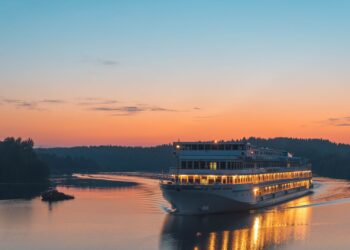

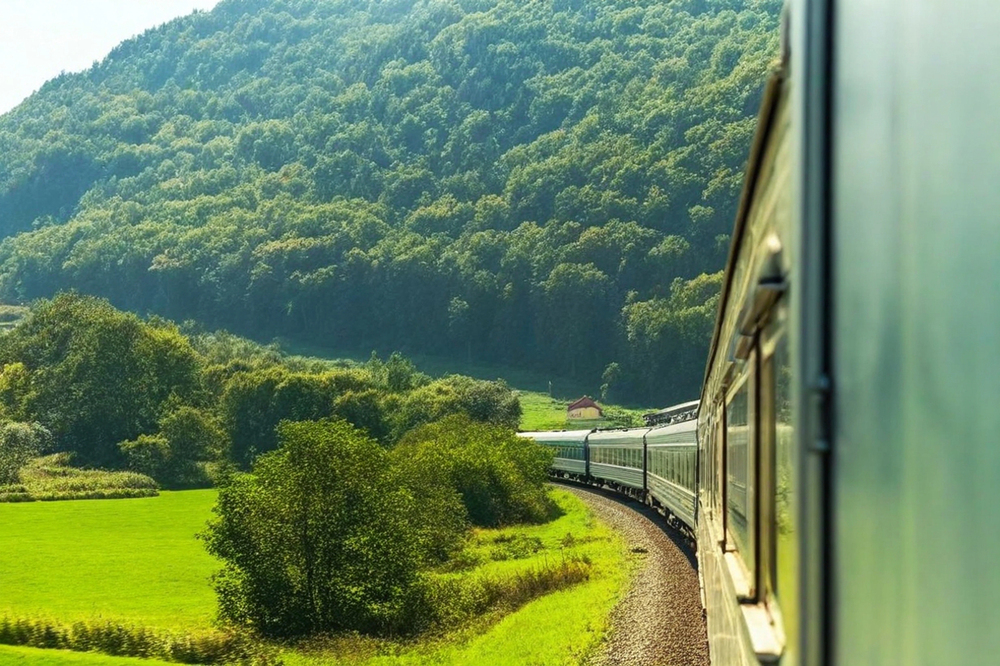

The journey stopped being the point somewhere along the way. The best train routes are bringing it back.
Something shifted in the way most people think about getting from one place to another when air travel became the default mode for anything beyond driving distance. The journey became a cost: a block of time to be minimized, endured, and subtracted from the useful portion of the trip. You leave, you arrive, the hours in between are a kind of enforced suspension. The goal is to make them as short and as painless as possible. Train travel operates on a different logic entirely, and the travelers who understand this tend to become its most committed advocates. A great train journey does not ask to be endured. It asks to be inhabited. The landscape moves past at a speed that allows genuine observation rather than the compressed abstraction of a view from 35,000 feet. The carriage is a social space with a dining car and a corridor and the particular intimacy of shared movement through a changing world. You arrive at a city’s center rather than an airport an hour outside it. And the journey itself, the hours between departure and arrival, has produced something: a sense of the land traversed, the distance covered, the gradual transition from one place to another that flying collapses into nothing. The global renaissance of interest in rail travel is not purely sentimental. It reflects a growing awareness of aviation’s environmental cost, a fatigue with the specific indignities of airport processing, and a recognition that several of the world’s greatest train routes offer an experience of travel that no other mode of transport can replicate. This is a guide to the routes and the reasoning that make train journeys worth building a trip around.
The Case for Overnight Trains
The overnight sleeper train represents one of travel’s most elegant solutions to a practical problem. You need to cover distance. You also need to sleep. The sleeper train does both simultaneously, delivering you to your destination in the morning having neither wasted a day traveling nor paid for a night’s accommodation. European overnight rail has undergone a genuine revival after a period of decline that saw many routes discontinued in the early 2000s when budget airlines made day flights cheaper than sleeper berths. The Austrian national carrier ÖBB’s Nightjet network has led this revival, reinstating and expanding overnight connections across Central Europe with modern rolling stock that offers private compartments, decent bedding, and breakfast included in the ticket price. Routes connecting Vienna to Paris, Amsterdam, Rome, and a growing number of secondary cities have restored connections that a generation of European travelers had given up as lost. The practical mathematics of an overnight train are worth stating clearly. A sleeper berth from Vienna to Paris, booked in advance, costs a fraction of what a business class flight costs and delivers the passenger to the city center at a civilized morning hour, having slept in something approximating a bed, with no airport transfer at either end. For environmentally conscious travelers, the carbon comparison with flying is similarly favorable. The train produces a fraction of the emissions of the equivalent flight, a differential that matters increasingly to travelers who are thinking seriously about the environmental arithmetic of their choices. The Trans-Siberian Railway represents the apotheosis of the sleeper train concept: a journey of nearly 9,300 kilometers across the full width of Russia from Moscow to Vladivostok, taking approximately six days on the fastest service and passing through eight time zones, the southern edge of Siberia, and a landscape that transitions from European Russia through the Ural Mountains into the vast boreal forest and steppe of Central Asia. It is not a comfortable journey in the conventional sense. The carriages are Soviet-era infrastructure, the food options are limited to what vendors sell through carriage windows at station stops, and six days in a moving train requires a particular tolerance for confinement and uncertainty. It produces, by virtually universal account, one of the most singular travel experiences available anywhere in the world.
Europe’s Greatest Scenic Routes
European rail infrastructure is the densest and most interconnected in the world, and within it several routes stand apart not merely as efficient connections between cities but as journeys of genuine scenic and experiential quality. The Bernina Express, running between Chur in Switzerland and Tirano in northern Italy via the Engadin valley and the Bernina Pass, covers one of the most dramatic pieces of railway engineering in existence. The line climbs to 2,253 meters above sea level, crossing the Alps on a route that includes spiral viaducts, glacial landscapes, and the particular visual drama of a train moving through a high mountain environment with the measured confidence of infrastructure that has been doing exactly this for over a century. The journey takes approximately four hours, and UNESCO has recognized the line as a World Heritage Site for the engineering achievement it represents. Booking a panoramic car in the window seat on the correct side of the train for the direction of travel is the single most important logistical decision the journey requires. The Bergen Railway in Norway connects Oslo to Bergen across the Hardangervidda mountain plateau, the largest high mountain plateau in Northern Europe, at elevations that leave the train traveling through a landscape that feels genuinely arctic even in summer. The journey takes approximately seven hours and passes through fifty tunnels and over more than three hundred bridges. At Myrdal, passengers can transfer to the Flåm Railway, one of the steepest standard-gauge railways in the world, which descends through a valley of waterfalls and granite walls to the Aurlandsfjord. The combination of these two routes in a single day of rail travel covers more visual variety than most destinations offer in a week. The Glacier Express, marketed as the world’s slowest express train, connects Zermatt to St. Moritz through the Swiss Alps in approximately eight hours. The name is both accurate and somewhat misleading: the train is slow by express standards because the route it traverses, 291 bridges and 91 tunnels across mountain terrain that defeated road builders for generations, does not permit speed. What it permits instead is sustained immersion in alpine landscape that changes continuously for eight hours, viewed through panoramic windows with a meal and a drink from the dining car, at a pace that allows genuine attention to what is passing outside.
Asia’s Rail Journeys of Note
Asia’s rail network contains some of the world’s most technically impressive and most culturally rich train journeys, operating across a range of comfort standards and price points that reflects the enormous diversity of the continent. Japan’s Shinkansen network is the most efficient high-speed rail system in the world by any operational metric: the average delay across the entire network, measured over decades of operation, is consistently under a minute. Traveling on the Shinkansen is itself an experience, not because of scenery, the trains travel too fast for detailed landscape observation, but because of the seamless, almost ceremonial quality of Japanese rail culture. The precision of departure times, the cleanliness of the carriages, the station ekiben, the boxed meals sold on platforms designed to be eaten on the train, the glimpse of Fuji-san through the window on clear days on the Tokaido line between Tokyo and Kyoto: these details accumulate into an experience of travel as a refined practice rather than a means to an end. The Darjeeling Himalayan Railway, a narrow-gauge mountain line in the Indian state of West Bengal, covers the 88 kilometers between New Jalpaiguri and Darjeeling in approximately seven hours on the toy train, a steam-hauled service that has operated since 1881 and is another UNESCO World Heritage railway. The train climbs more than 2,000 meters through tea gardens, forest, and mountain villages, sharing the road with traffic in the town sections and looping back on itself through engineering reversals that gain altitude in confined spaces. It is slow, occasionally unreliable, and utterly unlike any other train journey on earth. The Eastern and Oriental Express, running between Singapore and Bangkok through Malaysia and Thailand, represents the luxury end of Asian rail travel in the tradition established by the Venice Simplon-Orient-Express in Europe. Private cabins, formal dining, observation cars, and curated excursions at stops along a three-night route through tropical landscape and border crossings place it firmly in the category of train journey as the primary experience rather than as transport between destinations.
The Practicalities of Planning a Rail Journey
The booking infrastructure for train travel varies enormously by region and has historically been one of the genuine frustrations of rail travel compared to the frictionless booking experience of air travel. European rail has improved substantially in this respect. Rail Europe and Eurail provide consolidated booking across multiple national networks, and the direct booking sites of individual operators, SNCF in France, Deutsche Bahn in Germany, Trenitalia and Italo in Italy, have become more accessible to international users. Rail passes, the descendants of the classic Eurail pass that generations of travelers used to explore the continent, remain genuinely useful for travelers covering multiple countries across several weeks, though the advance booking discounts available on fixed-date tickets frequently undercut the per-journey pass cost for travelers with defined itineraries. Seat61.com, a website maintained by a single rail travel enthusiast with obsessive attention to detail, remains the most comprehensive and most reliable English-language resource for planning any train journey anywhere in the world. Its route-by-route guides cover booking options, operator quality, scenic highlights, and practical logistics with a depth that no commercial booking platform approaches. For anyone planning a significant rail journey for the first time, it is the starting point that makes everything else simpler. The principle that unifies every great train journey, from a six-day crossing of Siberia to a four-hour crossing of the Swiss Alps, is the same one that makes the mode of transport worth returning to: the journey itself has value independent of the destination it connects. In a world that has optimized relentlessly for the speed of arrival, that is a more radical proposition than it sounds.